

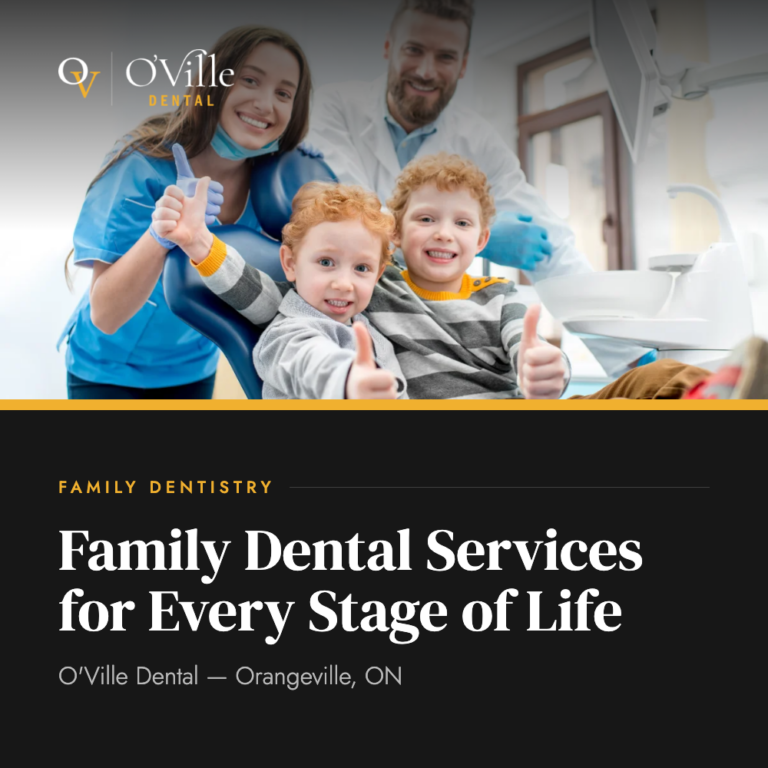
Family dental services bring dental care for every member of the household together under one roof, which can make life considerably simpler for Orangeville families juggling school runs, work and everything in between. Rather than sending children to one provider and adults to another, family dental services combine preventive care, routine examinations and appropriate treatments while adapting care to each patient’s age, oral health, development and individual needs. At O’Ville Dental, that includes evening hours on Tuesdays and Saturday morning appointments, which can make it easier to fit a whole family’s visits around a school and work week rather than taking time off for every appointment. Family dental services are dental care designed to meet the oral health needs of patients at different stages of life, including children, teenagers, adults and seniors, and they may include preventive care, routine examinations, professional cleanings and restorative treatments tailored to each patient’s individual needs. That last point matters: choosing a family dentist does not mean every family member follows the same treatment plan or the same appointment schedule, since a toddler’s needs and a grandparent’s needs are rarely the same thing.
What Are Family Dental Services?
Family dental services provide dental care across a household’s full age range rather than focusing on just one group, and that is the main way they differ from care designed around children alone or adults alone. In practice, this means a single dental practice can offer continuity of care for children, teenagers, adults and seniors as they move through different life stages.
Having care organised around the whole family, while still keeping each person’s treatment individualised, offers a practical benefit: parents can bring multiple children to appointments on the same day, adults can maintain their own preventive routine alongside their children’s, and the same dental team gets to know a family’s history over time rather than starting from scratch with every new provider.
Family Dentistry Across Different Life Stages
Oral health priorities shift as people age, and a family dentist typically adjusts focus accordingly.
| Life Stage | Common Dental Priorities |
| Children | Developing good oral hygiene habits, monitoring dental development and preventing cavities |
| Teenagers | Preventive care, oral hygiene, orthodontic considerations and monitoring developing teeth |
| Adults | Preventive care, gum health, restorative needs and maintaining existing dental work |
| Seniors | Maintaining natural teeth, gum health, restorative care and adapting care to changing oral health needs |
These are general considerations rather than fixed rules. Two people in the same age group can have quite different dental needs depending on their individual oral health history.
Preventive Care Included in Family Dental Services
Preventive dentistry sits at the centre of family dental services, since catching a problem early is usually simpler and less invasive than treating it once it has progressed. Common preventive services include:
- Routine dental examinations
- Professional dental cleanings
- Plaque and tartar removal
- Fluoride treatments when appropriate
- Dental sealants for eligible patients
- Oral cancer screening where clinically appropriate
- Monitoring tooth and gum health
- Personalised oral hygiene guidance
Regular preventive visits, such as those covered under routine checkups and cleanings, can help identify potential concerns before they become more complicated. They do not, however, guarantee that dental problems will never develop, since some issues arise regardless of how consistent a patient’s home care and check-up routine is.
Children’s Preventive Dental Care
Age-appropriate preventive care matters for children because their teeth, jaws and habits are still developing. This typically covers:
- Monitoring primary and permanent teeth
- Teaching children effective brushing and flossing
- Fluoride use when appropriate
- Cavity prevention
- Dental sealants where indicated
- Monitoring oral development
- Helping children become comfortable with dental visits
Practices that treat children regularly often build their approach around making visits manageable, though this does not mean every child will find dental appointments easy or anxiety-free. According to Canada.ca’s guidance on children’s oral health, consistent brushing habits and limiting sugary snacks and drinks are among the most effective ways parents can support their child’s oral health between visits.
Adult Preventive Dentistry
For adults, preventive care typically includes routine examinations, professional cleanings, gum health checks, cavity detection, monitoring of existing restorations, oral hygiene guidance and discussion of lifestyle factors that may affect oral health, such as diet, smoking or grinding. Canada.ca’s oral health information for adults notes that gum disease affects a large proportion of Canadian adults, which is one reason it is worth maintaining regular dental care even when nothing feels wrong. Cavities and early gum disease often develop without obvious symptoms, so skipping check-ups because everything seems fine can mean a problem is only caught once it is already more advanced.
Senior Dental Care
Senior dental care often needs to account for changes that build up over a lifetime of wear, medication use and general aging. Considerations include:
- Natural tooth preservation
- Gum health
- Dry mouth
- Existing dental restorations
- Dentures
- Difficulty maintaining oral hygiene
- Medication-related oral health considerations
- Changes in chewing or comfort
Research on oral health among Canadian seniors, published in the Journal of the Canadian Dental Association, has found that older adults face a higher likelihood of gum disease and reduced saliva production, partly linked to medication use and other age-related factors. The Ontario Dental Association’s guidance for seniors and caregivers points out that many people are keeping their natural teeth for longer than in previous generations, which makes ongoing gum health and dry mouth management more relevant to senior dental visits than ever. None of this means every senior patient faces the same issues; individual health history plays a large role in what a senior’s dental care actually looks like.
Dental Services for Children, Teens and Adults
Family dentistry covers a wide range of treatments, and which ones apply to a given patient depends entirely on their age, development and oral health.
Dental Services for Children
Children’s dental services may include dental examinations, professional cleanings, fluoride treatments where appropriate, dental sealants, cavity prevention and treatment, monitoring of dental development, oral hygiene education and management of common paediatric dental concerns. Age-appropriate communication and a focus on prevention are central to this kind of care, since building good habits early tends to matter more than any single treatment.
Dental Services for Teenagers
Adolescence brings its own set of dental considerations, including routine examinations, professional cleanings, cavity prevention, gum health, oral hygiene around orthodontic appliances, monitoring of wisdom teeth, and sports-related mouthguard discussions where relevant. Teenagers often benefit from taking on more responsibility for their own oral hygiene during this stage, while still having parents and dental professionals available for guidance.
Adult Dental Services
Adult dental care can involve both preventive and restorative services. Depending on individual needs, this may include examinations, cleanings, fillings, crowns, root canal treatment, gum health care, tooth replacement, and cosmetic dental services. Not every adult needs every one of these services; a dentist typically recommends specific treatment based on what a patient’s mouth actually requires rather than working through a standard list.
Senior Dental Services
Senior patients often need care that reflects their natural teeth, existing restorations, dentures and overall oral health. Potential services include preventive examinations, professional cleanings, gum care, restorative treatment, denture-related care, tooth replacement options such as dental implants, and ongoing monitoring of existing dental work. The focus at this stage is generally on preserving comfort, function and oral health in a way that fits each patient’s particular circumstances, rather than applying a single approach to every senior patient.
Benefits of Choosing a Family Dentist
Families choose a family dentist for reasons that go beyond simple convenience, though convenience is a real part of it. At O’Ville Dental, Dr. Ahmed Sami Alkhalili and Dr. Shahad Alkhalili, both registered with the Royal College of Dental Surgeons of Ontario, see patients across these age groups at the practice’s 4th Avenue location, so families aren’t choosing between “the kids’ dentist” and “the adults’ dentist” at all.
Convenient Family Dental Care
Having one dental practice that can see multiple family members offers practical advantages: simplified appointment planning, familiarity with the practice, consistent communication, easier access to preventive care, and continuity as children grow into adulthood. O’Ville Dental’s hours run later on Tuesdays (to 7 PM) and include Saturday mornings, which can help when coordinating appointments for more than one family member around school and work schedules. Appointment availability and scheduling arrangements vary by practice, so it is worth confirming these details directly rather than assuming a particular level of flexibility.
Consistent Preventive Care
Regular dental visits help families build ongoing preventive routines. Parents can model positive dental habits for their children, while adults and seniors in the same household maintain their own individualised care plans, all coordinated through the same practice.
Familiarity and Comfort
Visiting the same dental practice over time helps patients become familiar with the dental team and the environment itself. For children and patients who feel anxious about dental visits, clear communication, gradual exposure and age-appropriate explanations can help make appointments more manageable, though this does not guarantee that every patient will be free of dental anxiety. O’Ville Dental’s overview of family dentistry in Orangeville goes into more detail on how this kind of continuity works in practice.
Coordinated Dental Care
A family dental practice is often well placed to notice when a patient needs additional services or a referral to another dental or healthcare professional, since the same team is tracking each person’s oral health over time. Even with this coordination, each patient’s treatment plan should stay individualised to their own needs rather than following anyone else’s in the household.
How Often Should Families Visit the Dentist?
There is no single schedule that applies to every person in a family. Visit frequency can depend on:
- Age
- Oral health
- History of cavities
- Gum health
- Existing dental conditions
- Risk factors
- Current treatments
- Individual recommendations from the dental professional
While many people are familiar with the idea of a six-monthly check-up, this is not a fixed rule for everyone. Some patients need more frequent visits, and others may be advised differently by their own dental professional based on their specific history.
Dental Visit Frequency by Life Stage
| Patient Group | What to Consider |
| Children | Regular monitoring of developing teeth and preventive needs |
| Teenagers | Ongoing preventive care and monitoring of changing oral health |
| Adults | Routine examinations and preventive care based on individual risk |
| Seniors | Continued preventive care with attention to changing oral and restorative needs |
The dental team may recommend a different frequency than this general table suggests, depending on a patient’s individual circumstances.
If a family member develops a concerning symptom between visits, that is a different question from how often to book routine care. O’Ville Dental’s guide to recognising a true dental emergency walks through how to tell the two apart.
Choosing Family Dental Services in Orangeville
A family dentist Orangeville households can rely on for the long term should hold up across all these factors, not just one or two: whether the practice provides care for multiple age groups, its approach to prevention, and how well it fits your household’s schedule. O’Ville Dental serves families across Orangeville, Mono, Amaranth, Shelburne and Caledon from its 4th Avenue location, and accepts the Canadian Dental Care Plan alongside direct insurance billing. For a closer look at how to weigh a decision like this, O’Ville Dental’s guide to choosing a local dentist covers the fuller set of questions worth asking.
Family Dental Services Cost Considerations
The cost of family dental services varies according to what each family member actually needs. Potential cost factors include:
- Routine examinations
- Professional cleanings
- Preventive treatments
- Restorative procedures
- Paediatric dental treatments
- Gum treatment
- Dentures or tooth replacement
- Additional diagnostic procedures
This guide does not quote specific prices, since costs change and vary by provider and by patient. Dental insurance or benefits coverage can also vary considerably between individuals and plans. Some families may also be eligible for government support; the Canadian Dental Care Plan outlines the categories of care it can help cover, including preventive, basic and major dental services, for those who qualify. O’Ville Dental accepts the CDCP directly and submits insurance claims on patients’ behalf, which is worth knowing if you’re weighing cost alongside coverage. Because coverage and eligibility can be complex, it is worth discussing treatment costs, insurance coverage and available payment information directly with the dental practice before proceeding with any recommended care.
Choosing family dental services means giving children, teenagers, adults and seniors in the same household access to preventive and restorative dental care that adjusts to each person’s stage of life, rather than trying to fit everyone into the same plan. If your family is due for a check-up, or you would like to talk through what ongoing dental care might look like for the different people in your household, it is worth scheduling an assessment or routine visit based on each person’s individual needs.
Frequently Asked Questions
What are family dental services?
Family dental services provide dental care for patients across different stages of life, including children, teenagers, adults and seniors, generally through the same dental practice. Services may include preventive examinations, cleanings, patient education and restorative treatments tailored to each individual rather than applied the same way across every family member.
What treatments are included in family dental services?
Common services include dental examinations, professional cleanings, fluoride treatments, sealants, fillings, crowns, gum care, children’s dental services, denture-related care and tooth replacement options. Exactly which services are offered and recommended depends on the individual dental practice and each patient’s specific needs, so not every family member will use the same list of treatments.
Are family dental services suitable for children?
Yes, family dentistry can include age-appropriate children’s dental care, such as preventive examinations, cleanings, fluoride, sealants and monitoring of dental development where appropriate. Care for children should be individualised based on their age and oral health, since a toddler’s first visit looks quite different from a routine check-up for an older child.
How often should families use family dental services?
Appointment frequency varies by age, oral health, dental history and individual risk factors, so there is no single schedule that fits every person. Rather than assuming a fixed interval applies to everyone in the household, it is best for each family member to follow the interval recommended by their own dental professional.
What are the benefits of family dental services?
Benefits can include convenient access to care for different family members, consistent preventive care, familiarity with the dental practice, age-appropriate dental education, earlier identification of oral health concerns, and continuity of care as family members move through different life stages. The value comes from individualised care coordinated in one place, rather than every family member receiving identical treatment.