

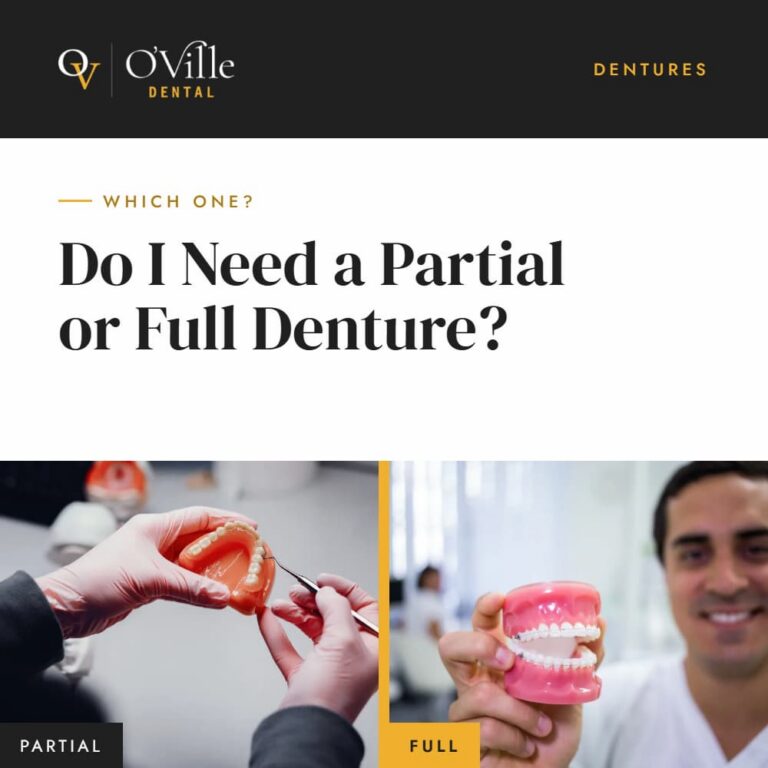
Comparing partial and full dentures can help you prepare for a more informed conversation with your dentist about replacing missing teeth.
If you’re missing one or more teeth, you may be comparing partial or full dentures to understand which option could fit your situation. Partial dentures replace some missing teeth while using your remaining natural teeth for support, while full dentures replace an entire arch of missing teeth. Both options can help restore appearance and everyday oral function, though fit, comfort and suitability vary from person to person. A dentist should evaluate your teeth, gums, jawbone and overall oral health before recommending either option.
Quick-Answer Verdict
Partial dentures are generally considered when some healthy natural teeth remain. Full dentures are generally used when all teeth in the upper jaw, lower jaw or both need to be replaced. The appropriate option depends on the condition of your remaining teeth, gums, jawbone, oral health, personal preferences and budget. Both are removable denture options and may require an adjustment period, professional maintenance and eventual replacement. A dentist must examine you before recommending a suitable treatment.
This guide is intended to support your general understanding of partial and full dentures. It does not replace an individual dental assessment.
What Is the Difference Between Partial or Full Dentures?
Partial dentures replace one or more missing teeth while relying on suitable remaining natural teeth for support, whereas full dentures replace all of the teeth in an upper or lower dental arch and rest primarily on the gums and underlying oral tissues. The right option for you depends on how many teeth are missing, the condition of any teeth you have left, and how each appliance would be supported in your mouth.
Designs, materials and support methods can vary between patients and providers, so not every partial or full denture is constructed the same way.
In short, partial dentures replace some missing teeth and generally rely partly on suitable remaining teeth for support. Full dentures replace all teeth in an upper or lower arch and rest primarily on the gums and supporting oral tissues.
When Are Partial Dentures Recommended?
Partial dentures may be considered when you have one or more missing teeth but still have natural teeth healthy enough to retain. A dentist typically discusses this option when:
- Several teeth are missing in one or more areas of the mouth
- Suitable natural teeth remain to help support the appliance
- You want a removable tooth-replacement option
- Fixed options may not be suitable or preferred
- You want to restore gaps without removing healthy teeth unnecessarily
- Your budget, anatomy or personal preference supports this option
Potential benefits include retaining suitable natural teeth, replacing several teeth with one appliance, supporting appearance, speech and chewing, being removable for cleaning, and adapting to different patterns of tooth loss.
Potential limitations include an adjustment period, visible clasps or components in some designs, the need for careful cleaning of supporting teeth and gums, fit changes as oral tissues change over time, and the possibility of future repairs, relining or replacement.
Having remaining teeth does not automatically make you a suitable candidate. Their condition, position and ability to support a denture must be professionally assessed.
When Are Full Dentures Recommended?
Full dentures may be considered when all teeth are missing from one or both arches, or when remaining teeth cannot be predictably retained. This may apply when:
- All teeth in an arch are already missing
- Remaining teeth have a poor long-term prognosis
- Extensive tooth loss is affecting function and appearance
- You need a complete removable replacement
- Other replacement treatments are unsuitable, unavailable or not preferred
Potential benefits include replacing a complete arch of missing teeth, supporting facial appearance, potentially improving speech and chewing compared with having no teeth, being removable for cleaning, and being available for the upper arch, lower arch or both.
Potential limitations include an adjustment period, lower dentures that may feel less stable for some wearers, fit that can change as gums and jawbone change over time, adhesive that may help some wearers but should not compensate for a persistently poor fit, and the possibility of periodic adjustments, relining or replacement. Function may also differ from that of natural teeth.
Immediate dentures (fitted soon after extractions) and conventional dentures (fitted after healing) are both options in some cases. Your dentist will determine the appropriate timing and suitability for your circumstances.
How Do You Choose Between Partial or Full Dentures?
The decision is mainly determined by whether suitable natural teeth can be retained. Personal preferences, oral health, anatomy, maintenance requirements and cost also matter.
| Factor | Why It Matters |
| Number of missing teeth | The extent and location of tooth loss influences which treatments are available to you. |
| Condition of the remaining teeth | Decay, gum health, mobility and the ability of remaining teeth to support a partial denture all matter. |
| Gum and jawbone health | Oral tissues and bone structure affect how well a denture is supported and how stable it feels. |
| Denture fit and comfort | Anatomy, saliva, healing and changes in the mouth can all affect fit, and professional adjustments may be necessary over time. |
| Appearance | Tooth shade, shape, base colour and appliance design may be personalised, though results vary between patients. |
| Eating and speaking | Most people experience some adjustment period, and following your dentist’s advice can help. |
| Cleaning and maintenance | Cleaning around natural supporting teeth differs from caring for a complete removable appliance. |
| Budget and treatment goals | Cost should be weighed alongside suitability, longevity, maintenance and alternative treatments. |
This table is a preliminary comparison, not a diagnostic tool. Please don’t select a denture type based on the table alone. A dentist needs to examine your teeth, gums and jawbone before making a recommendation.
How Long Do Partial or Full Dentures Last?
There is no universal lifespan for removable dentures. Longevity depends on materials, daily care, changes in your mouth over time, wear, damage, and the condition of any supporting teeth and tissues.
Factors affecting lifespan include daily cleaning and handling, wear to the denture teeth or base, changes to gums and jawbone, the condition of natural supporting teeth, teeth grinding or clenching, accidental damage, changes in your oral or general health, how often you attend dental assessments, and the quality of the original fit and construction.
Signs a denture may need attention include looseness or movement, recurring sore areas, cracks, chips or broken components, difficulty chewing, speech changes, changes in facial support, food collecting beneath the appliance, increased reliance on adhesive, damage to clasps, and discomfort around supporting teeth.
Depending on the cause, your dentist may recommend an adjustment, repair, reline or replacement. There is no fixed replacement interval that applies to every patient.
How Much Do Partial or Full Dentures Cost?
The cost of partial or full dentures varies according to the appliance, materials used, clinical requirements, location and any additional treatment needed.
Cost factors include whether a partial or full design is used, the number of arches being treated, materials used, the complexity of the denture, examinations and diagnostic records, tooth extractions or other preparatory care, laboratory fees, adjustments and follow-up appointments, repairs or relining, dental insurance or applicable public dental coverage, and geographic location and provider fees.
Questions worth asking your dentist include what is included in the quoted fee, whether follow-up adjustments are included, whether extractions or other dental treatment could be required, what materials are recommended and why, what future maintenance costs you should expect, whether any part of the treatment is eligible for insurance or public-program coverage, and whether alternative tooth-replacement options are appropriate for you.
If you’re a Canadian resident, you may want to ask whether any part of your treatment could be eligible under the Canadian Dental Care Plan. This guide does not imply that dentures or all related costs are automatically covered. Eligibility and coverage should be verified through official CDCP sources, since program rules can change.
How Should You Care for Partial or Full Dentures?
General care information is provided here, but you should follow the personalised instructions your dentist gives you.
Daily care topics include removing and cleaning the denture as directed, using denture-appropriate cleaning products, avoiding abrasive household products, cleaning the gums, tongue and other oral tissues, carefully cleaning any remaining natural teeth (paying particular attention to teeth supporting a partial denture), handling the appliance carefully to reduce the chance of damage, storing it according to professional instructions, attending routine dental checkups and cleanings, and arranging an assessment if the denture becomes uncomfortable or loose.
Important safety points: do not adjust, bend or repair a denture at home. Do not use household glue on a damaged appliance. Do not rely on adhesive to manage a persistently loose or painful denture. Seek professional advice for sores, swelling, bleeding, pain or broken components. Wearing instructions can vary, so always follow your own dentist’s recommendations.
What Other Denture Options Could Be Considered?
Conventional partial and full dentures are not the only tooth-replacement choices available. Depending on your oral health, anatomy, medical considerations, treatment goals and budget, your dentist may also discuss fixed dental bridges, dental implants, implant-supported or implant-retained dentures, immediate dentures, or alternative partial-denture materials and designs. A dentist can help you understand whether any of these alternatives may be appropriate following an individual assessment.
Conclusion
Partial dentures generally replace some missing teeth when suitable natural teeth remain, while full dentures replace a complete upper or lower arch. Neither option is automatically better for every patient. Your oral health, supporting structures, fit, maintenance needs, treatment goals and budget should all guide the decision. A professional assessment is necessary to determine which treatment is appropriate for you.
If you are comparing partial or full dentures, schedule a dental assessment to review your remaining teeth, oral health and treatment goals. A general dentist at O’Ville Dental can explain the denture options that may be appropriate for your circumstances.
Frequently Asked Questions
What is the difference between partial or full dentures?
Partial dentures replace one or more missing teeth while retaining suitable natural teeth. Full dentures replace every tooth in an upper or lower arch. Both are typically removable, but they differ in their design and sources of support. A dentist can help determine which option fits your specific pattern of tooth loss.
Are partial or full dentures better for missing teeth?
Neither option is universally better. The suitable choice depends mainly on how many teeth are missing and whether your remaining teeth are healthy enough to retain. Oral anatomy, comfort, maintenance needs, personal goals and budget also affect the recommendation your dentist may make.
How do I know whether I need partial or full dentures?
Patients with suitable remaining teeth may be considered for partial dentures, while patients missing all teeth in an arch may need full dentures. A clinical examination and any relevant diagnostic records are required before a dentist can make a recommendation specific to your mouth.
How long do partial or full dentures last?
Denture longevity varies. Materials, daily care, oral changes, wear, accidental damage and the health of supporting tissues can all affect how long an appliance remains serviceable. Regular examinations help your dentist identify when adjustment, repair, relining or replacement may be needed.
Can partial or full dentures look natural?
Modern dentures can be designed to complement your smile and facial features. Tooth shade, shape, positioning and denture-base appearance may be personalised, but results depend on your clinical situation, the materials used and the design chosen. A denture cannot be guaranteed to be indistinguishable from natural teeth.
O’Ville Dental provides general dentistry services to patients in Orangeville, Mono, Amaranth, Shelburne and Caledon. This article is for general educational purposes and is not a substitute for an individual dental examination.